This quarterly meeting differs from the usual format in that there will be three speakers, forming a panel on Petrophysical Uncertainty. The meeting will be held at KIVI, Den Haag, starting at 4:00 pm (doors open at 3:30 pm), and there will be drinks and snacks afterwards at Café Hathor, around the corner.
Talk 1: Quantification, and Value Impact, of Vertical Depth Uncertainty
Speaker: Harald Bolt, DwpD Ltd., Depth Solutions, DPS, SPWLA, SPE, ISCWSA, EAGE, GESGB
Abstract:
Uncertainty in subsurface models stems from both the accuracy of acquired data and the calculation methods employed. These uncertainties directly affect the value of hydrocarbon initially in place (HCIIP) estimates, which underpin critical economic decisions about the viability of subsurface prospects. Key input parameters—including gross reservoir volume, sand count, porosity, fluid saturation, and conversion factors—are derived from a combination of seismic interpretation, wellbore measurements, petrophysical evaluation, and fluid characterization.
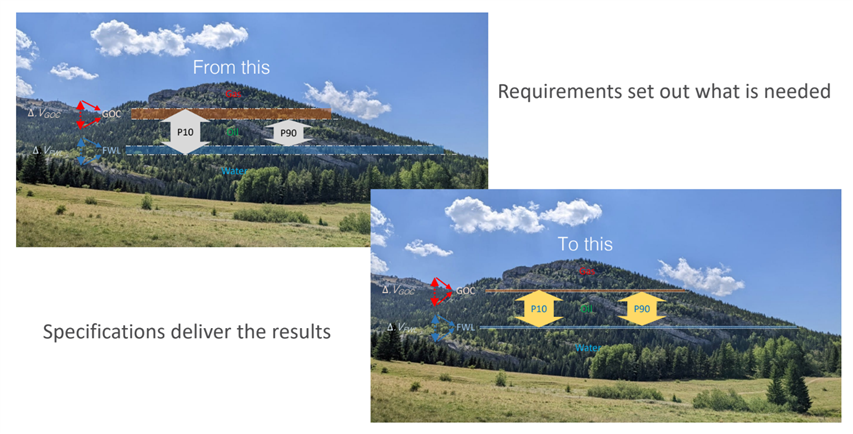
Traditionally, Vertical depth, and hence volumetric, uncertainty has been characterized by simplified rule-of-thumb and industry standard (ISCWSA) approaches. This presentation introduces a rigorous framework for quantifying Vertical depth uncertainty, explicitly linking technical accuracy specifications with economic value assessment. The method scrutinizes the contributory influence of each parameter within the standard HCIIP equation, aiming to optimize well survey design whilst taking a balanced approach to accuracy specifications.
Special attention is given to the impact of Vertical depth uncertainty on volumetric estimation. By controlling Vertical depth uncertainty to meet specified tolerances, operators can increase recoverable reserves and make more robust business decisions. The differences between the approach discussed and currently used industry standard (ISCWSA) methods is highlighted.
A practical example demonstrates how applying these quantification methods results in both enhanced value of HCIIP calculations as well as creation of greater stakeholder confidence in reserves estimation. This clearly highlights the tangible improvements in HCIIP value achieved through improved management of Vertical depth uncertainty.
Talk 2: Why the Long Transition Zone?
Speaker: Hans de Koningh, Senior Petrophysicist, Vermilion Energy
Abstract:
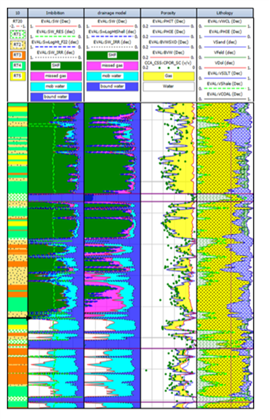
Fitting Saturation Height Functions derived from capillary pressure experiments to log derived water saturation data is often challenging. The petrophysicist has to make a choice how to deal with inconsistencies between the two data types and decide how to model the relationship between free water level, transition zone and irreducible water saturation on log and field scale. The implications on hydrocarbon in place estimates can be very significant, especially when fields combine significant transition zone length with a flat structure. Image below shows one of the wells where use of different SHF modelling approached results in different transitions zones. In this presentation examples of gas fields are shown where traditional drainage capillary pressure measurements are not easily reconciled with other data sources; resistivity based saturation estimates, Dean Stark analysis and production data. Via some examples strategies in dealing with the uncertainty of selecting an approach in reconciling these data types are discussed via two practical datasets.
Bio:
Hans de Koningh has been providing petrophysical support and consultancy, as a Senior Petrophysicist, to European subsidiaries of Vermilion Energy for the past seven years, having spent the first part of career working for various Shell operating companies (1997-2008) and then for SGS and Xodus Group in the Netherlands. He holds an MSc in Petroleum Engineering from Delft University of Technology.
Talk 3: Reducing Uncertainty in IRM through Knowledge: Handling of Fundamental and Inverted Properties
Speaker: Iulian Hulea, Petrophysics.eu
Abstract:
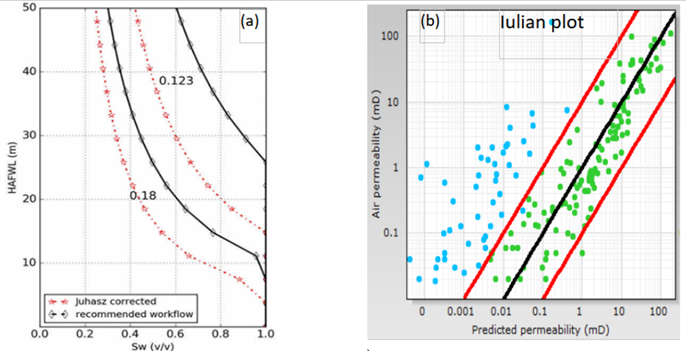
Saturation and permeability are two of the main properties making or breaking a project. Although intertwined, they are sometimes looked at in isolation without much consideration into the effect their input have on the predictions at the next stage. A typical issue is the creation of the SHM without much thinking of what happens once the model has been obtained, leading to unnecessary uncertainties. The parameters used in correlations might be straightforward to check but what state are the measurements in? Are they stressed, ambient? A common assumption seems to be that once obtained, a SHM needs to be “stress corrected”. Here we show how we can prevent uncertainty at least in this area, with potential dangerous effects (see Figure 1(a)) when those parameters and models find their way in the IRM.
When it comes to permeability, uncertainty can be reduced by a thorough QC of the data entering the model. Given the fact that porosity-permeability transforms rely on taking the matrix porosity/whole pore system and convert it to permeability, it becomes imperative discarding of random features unrelated to matrix porosity. The Iulian plot (see Figure 1(b)) provides an elegant method of discarding questionable plugs.